
 cathy@migodesk.com
 Click to WhatsApp (Cathy Liu)

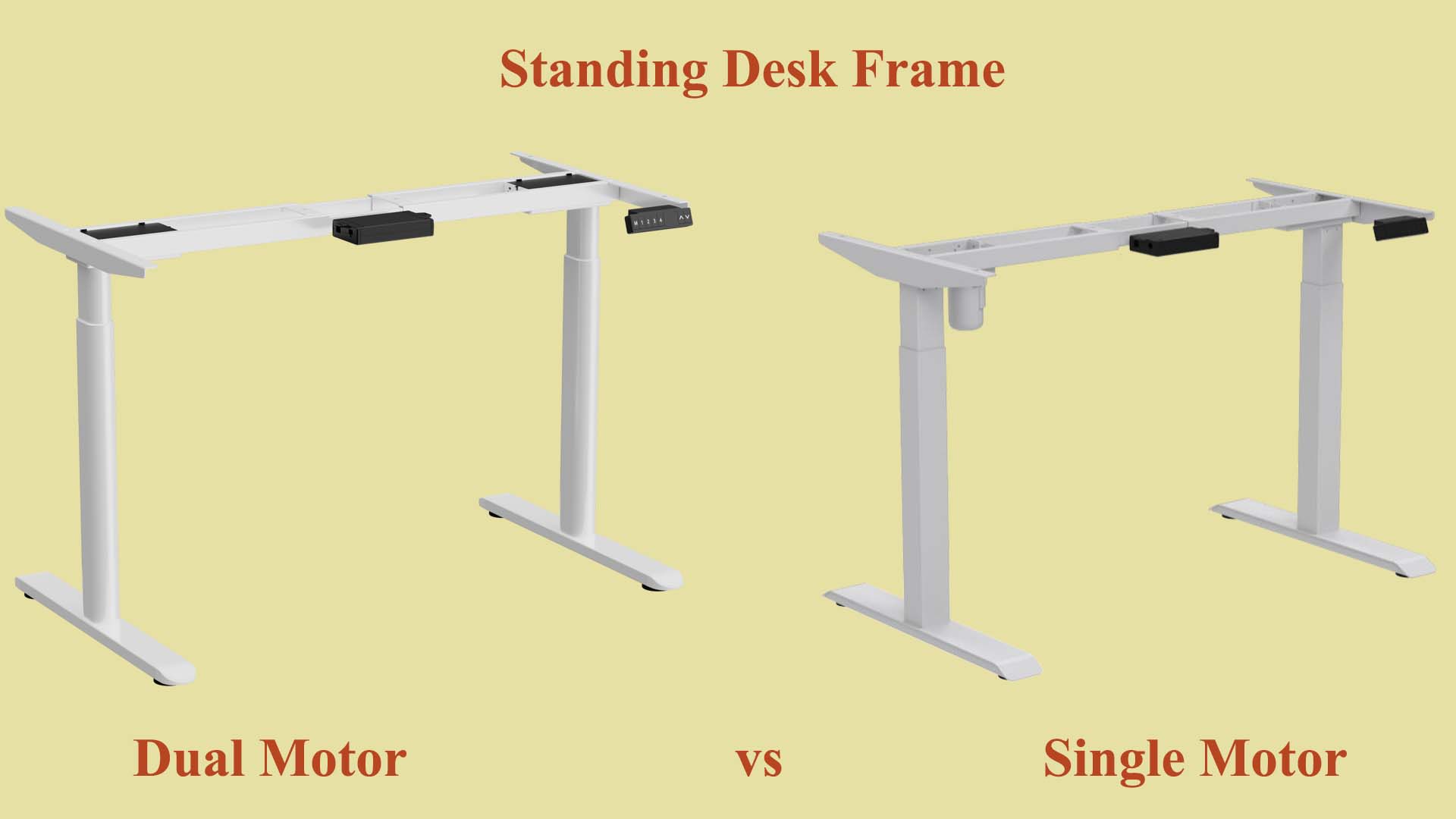
The choice between single-beam, fixed (non-moving) beam, and dual-beam structures in standing desks is closely tied to the actuation system (single vs. dual motor), mechanical stability, cost, and design priorities. Let’s break this down:
🔧 1. Why Single-Motor Desks Often Use Single or Fixed Beams
✅ Mechanical Simplicity & Cost Efficiency
- A single motor drives motion through a long rotating shaft (or timing belt) that connects the two legs.
- This shaft runs under the desktop, often mounted to a central crossbeam (the “single beam”).
- Using just one beam reduces material, assembly complexity, and cost—aligning with the budget positioning of most single-motor desks.
✅ Adequate Synchronization with One Motor
- Since both legs are driven by the same motor via a rigid shaft, they inherently move in sync.
- A single central beam provides enough torsional rigidity to transfer motion without needing a second beam.
✅ Fixed Beam Variant
- Some designs use a fixed rear beam (non-telescoping) + front single moving beam.
- The fixed beam adds structural support but doesn’t participate in lifting—it just stiffens the frame.
- This hybrid approach improves stability without adding a second actuator or complex linkage.
📌 Key Point: With only one power source, you don’t need two independent drive beams—so manufacturers simplify.
⚖️ 2. Advanced Single-Motor Desks: Why Some Use Dual Beams
A few premium single-motor models (e.g., some from Flexispot, Uplift’s older models) use dual beams—but with caveats:
🔹 Enhanced Stability
- Dual beams significantly reduce side-to-side wobble and front-back rocking, especially at max height.
- Square legs help, but dual beams add lateral bracing, improving perceived quality.
🔹 Better Weight Distribution
- Heavy loads (e.g., dual monitors, PCs) benefit from a stiffer frame.
- Dual beams distribute bending moments more evenly across the structure.
🔹 Trade-offs Accepted
- These desks accept higher cost/complexity for better user experience.
- They still use one motor + a long shaft connecting both legs—so synchronization isn’t an issue.
✅ So: Dual beams are possible with single motor—but not necessary for basic function.
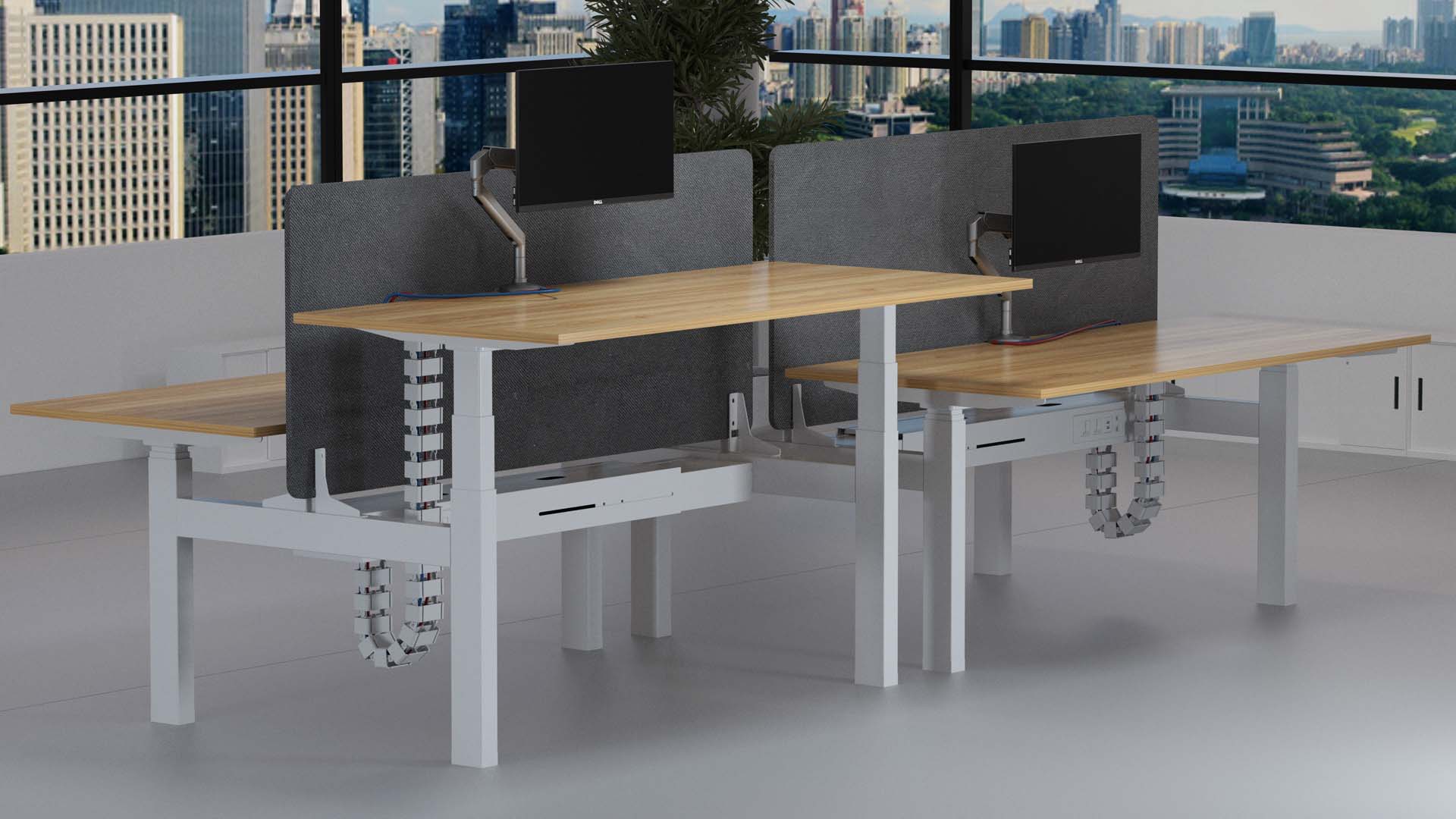
🚫 3. Why Dual-Motor Desks Almost Always Use Dual Beams
🔌 Independent Actuation Requires Structural Independence
- Each leg has its own motor, so motion must be electronically synchronized (via control box).
- Without a rigid mechanical link (like a long shaft), the frame needs two strong beams to:
- Prevent misalignment if one leg lags slightly.
- Maintain desk planarity under uneven loads.
🏗️ Dual Beams = Inherent Frame Rigidity
- Dual-motor desks target higher performance: faster lift, higher load capacity (e.g., 250–300 lbs), smoother operation.
- A dual-beam chassis is essential to handle these demands without excessive flex.
🔄 No Central Shaft Needed
- Since there’s no need to transmit torque from one side to the other, designers eliminate the central shaft.
- Instead, they rely on two parallel beams, each integrated with its own leg assembly.
❌ Single beam would be unstable here: without a mechanical sync shaft, a single beam can’t prevent legs from drifting out of alignment during lift.
🆚 Comparison Summary
| Feature | Single-Motor Desk | Dual-Motor Desk |
|---|---|---|
| Typical Beam Structure | Single beam or fixed + single | Dual beams (standard) |
| Synchronization Method | Mechanical (shaft/belt) | Electronic (control box) |
| Stability Priority | Moderate (cost-optimized) | High (performance-optimized) |
| Load Capacity | ~150–220 lbs | ~250–350+ lbs |
| Wobble Control | Acceptable at mid-height | Minimized even at full height |
| Cost Implication | Lower (fewer parts) | Higher (more motors + beams) |
💡 Key Insight:
Beam count follows actuation architecture.
- One motor → one driving axis → one main beam suffices.
- Two motors → two independent axes → dual beams required for rigidity and alignment.
Using a single beam on a dual-motor desk would create a mechanically under-constrained system, prone to twisting, binding, or asynchronous movement—even with good electronics.
✅ Conclusion:
- Single-beam/fixed-beam designs dominate single-motor desks due to simplicity, cost, and adequate performance.
- Dual-beam is standard for dual-motor desks because it’s structurally necessary for stability and synchronization.
- Premium single-motor desks may adopt dual beams as a value-added feature, but it’s not required for core functionality—unlike in dual-motor systems.
This reflects smart engineering trade-offs aligned with product tiering, user expectations, and physics.