
 cathy@migodesk.com
 Click to WhatsApp (Cathy Liu)

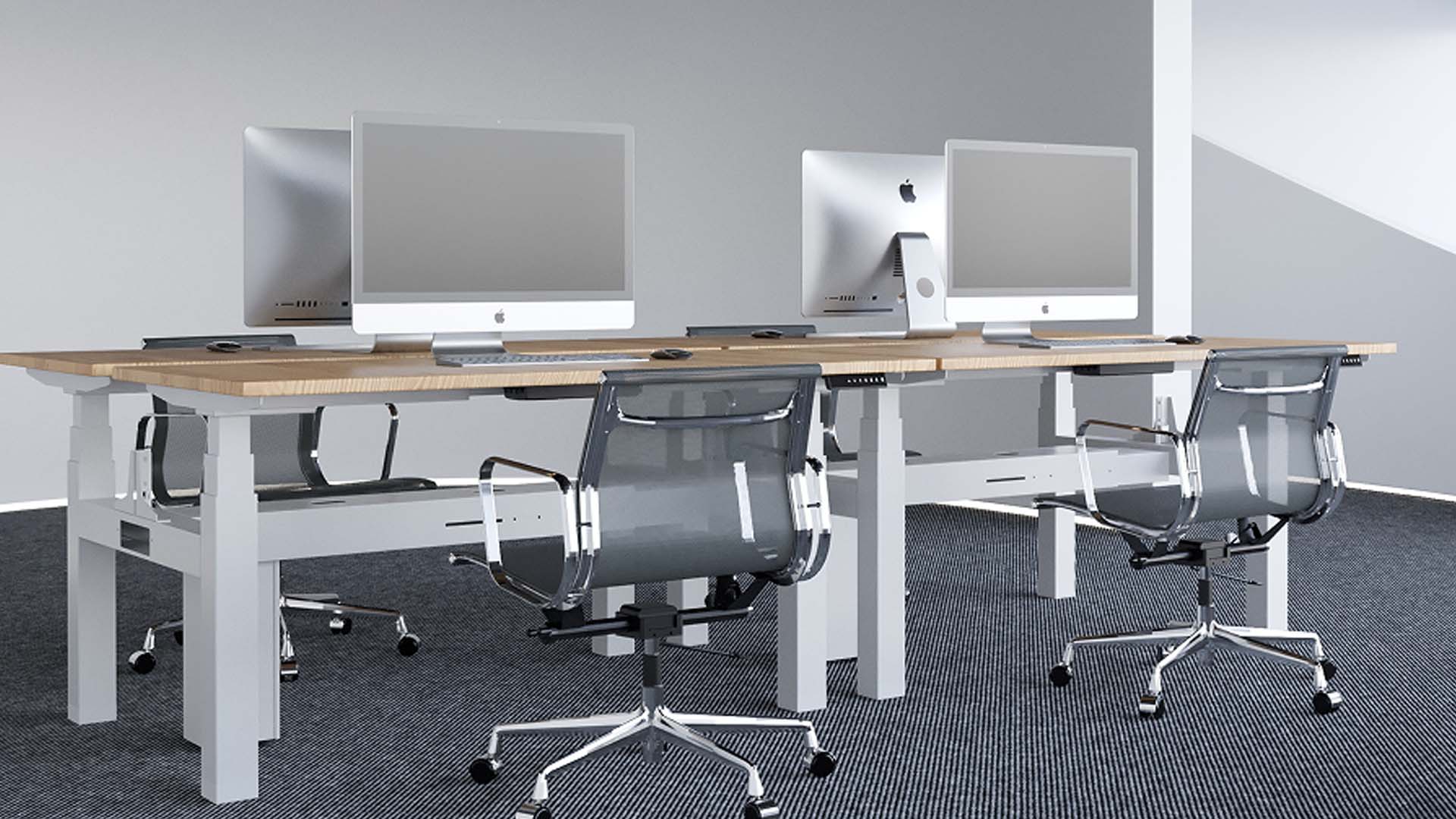
Frankly speaking, more consumers purchase dual motor standing desks globally. However, single motor standing desks still have their market share. Nowadays, for those global office furniture projects, a product manager or project manager often needs to consider a lot before fixing a new supplier. But out of the business options, perhaps we need to fully compare a typical dual motor standing desk to a typical single motor standing desk. That’s to say, we know it’s better but we must know why it’s better.
When sourcing electric height-adjustable desks for commercial or institutional use, motor configuration is not just a feature – it’s a design decision that affects performance, durability, and long-term value. For B2B buyers – OEMs, distributors, and procurement managers – the choice between single-motor and dual-motor systems goes beyond marketing claims. It’s about engineering logic, load distribution, user experience, and total cost of ownership.
Let’s break it down from an engineer’s perspective.
1. Motor Type & Core Mechanism: How They Work
Electric standing desks rely on motors to drive vertical movement. The two main types are:
- DC Motors: Compact, quiet (typically <50 dB), energy-efficient. Common in home-use models.
- AC Motors: Higher torque, better suited for heavy-duty applications. Often used in commercial-grade desks.
Both use either screw-driven or chain-driven mechanisms. But the real difference lies in how many motors power the system.
✅ Single-Motor System
One motor drives one side of the desk via a connecting rod or linkage system. This pulls both legs up or down through mechanical coupling.
Think of it like a seesaw with one person pushing at one end. The motion is transferred, but balance depends entirely on the mechanism’s precision.
Key Limitation: Mechanical linkages can slip under uneven loads or over time. This causes wobbling, misalignment, and instability—especially during heavy usage.
✅ Dual-Motor System
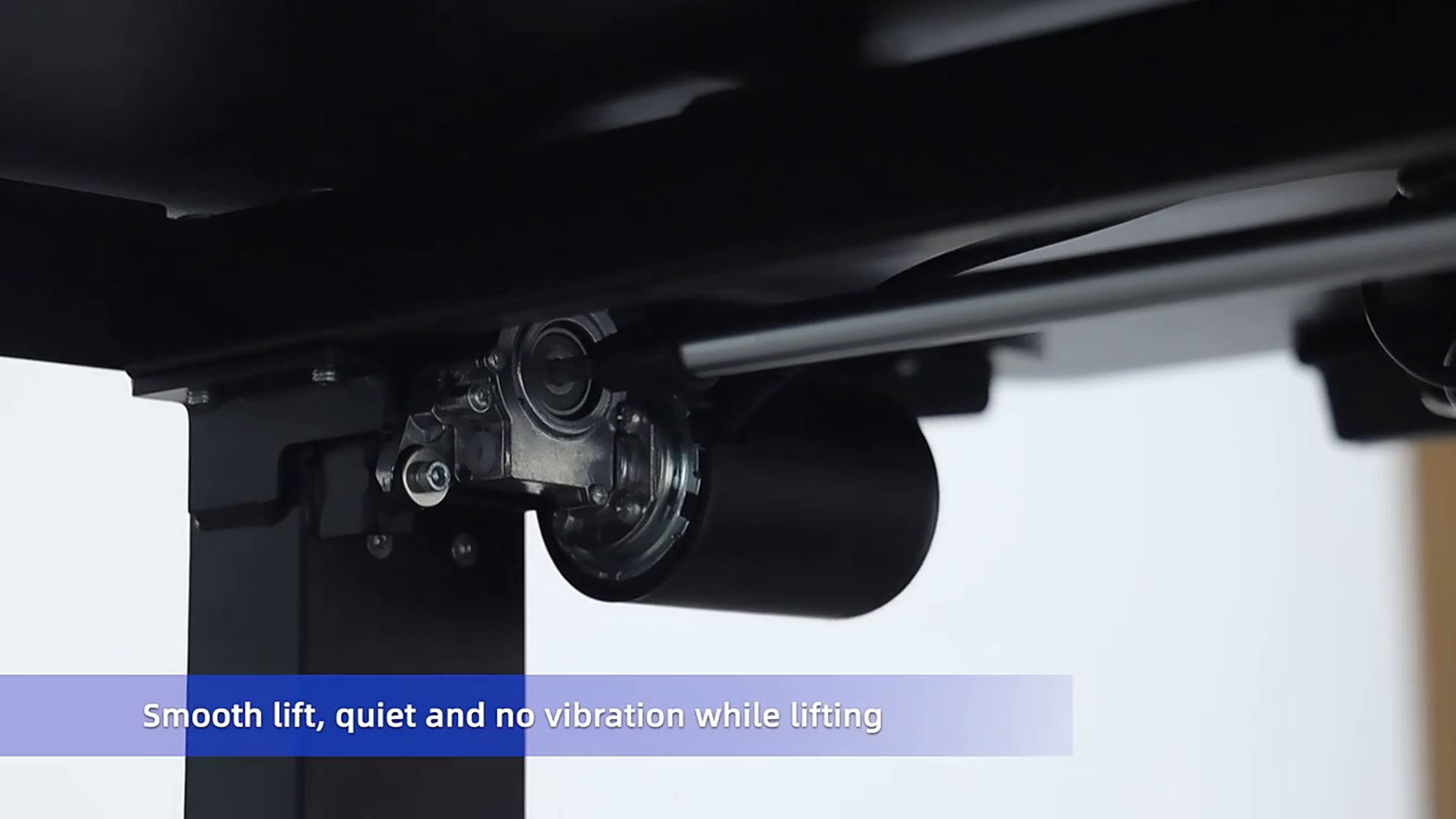
Each leg has its own motor. Both motors are synchronized by a central controller using feedback loops (often hall sensors or encoders). This ensures independent yet coordinated movement.
Like two people lifting a table—one on each side—working together in perfect sync.
This eliminates reliance on mechanical linkages and allows true parallel control.
2. Load Capacity: Not Just About Weight, But Distribution
| Feature | Single Motor | Dual Motor |
|---|---|---|
| Max Load | ~70 kg | ~100–150 kg |
| Frame Weight | <20 kg | Up to 28 kg |
Why this matters for B2B buyers:
- In corporate environments, desks often carry monitors, laptops, printers, docking stations, and even small servers.
- A 70kg limit may seem sufficient, but consider:
- Desk surface weight
- Equipment weight
- User habits (e.g., stacking files, books)
- Future-proofing
With dual motors, you’re not just adding more weight capacity—you’re improving load distribution. Each motor handles half the load independently. This reduces stress on any single component and improves longevity.
Also, heavier frames (up to 28kg) mean better stability and reduced tipping risk—critical in shared workspaces or high-traffic areas.
3. Speed & Smoothness: More Than Just Numbers
| Parameter | Single Motor | Dual Motor |
|---|---|---|
| Lift Speed | ~25 mm/s | ~35 mm/s |
| Stability | Prone to jerking/slippage | Consistent, smooth motion |
| Noise Level | Slightly higher due to slippage | Lower, controlled operation |
Speed isn’t everything. A faster speed doesn’t help if the desk shakes or stalls mid-rise.
Dual-motor systems achieve consistent speeds because:
- Both sides move simultaneously.
- Controllers monitor position and adjust output in real time.
- No dependency on mechanical tension or wear-prone linkages.
In contrast, single-motor designs suffer from speed fluctuation, especially when the desk is loaded unevenly. Over time, linkage fatigue leads to delayed response and inconsistent positioning.
For offices where employees adjust their desks multiple times a day, smooth, predictable motion increases satisfaction and reduces complaints.
4. Noise: The Hidden Cost of Poor Design
Noise levels vary based on motor quality and mechanism efficiency.
- High-quality DC motors: ≤45 dB (like a quiet conversation)
- Low-efficiency or worn-out systems: >60 dB (like a vacuum cleaner)
But here’s what most specs miss:
Single-motor desks tend to be noisier due to mechanical friction and slippage.
When the connecting rod slips, it creates a clunking sound. That noise becomes noticeable in open-plan offices.
Dual-motor systems avoid this because:
- No moving parts between legs
- Direct motor-to-screw engagement
- Soft-start technology reduces startup jolt
For businesses focused on acoustics (e.g., call centers, creative studios), low-noise operation is a non-negotiable factor.
5. Structural Integrity & Frame Design
The frame is only as strong as the system driving it.
🔹 Single-Motor Frames
- Typically lighter (<20 kg)
- Use thinner tubing and simpler joints
- Rely heavily on linkage strength
- Risk of deformation under sustained load
🔹 Dual-Motor Frames
- Can support heavier construction (up to 28 kg)
- Allow thicker steel tubing and reinforced joints
- Better resistance to lateral forces
- Ideal for large desktops (>160 cm wide)
For B2B clients supplying large-scale deployments (e.g., government agencies, hospitals, universities), frame robustness directly impacts maintenance frequency and replacement costs.
6. Control & Intelligence: What Happens Behind the Scenes
Dual-motor desks come with smarter electronics:
- Synchronization algorithms ensure both motors run at identical speeds.
- Position memory allows precise recall of preset heights.
- Error detection alerts users or systems if one motor fails or stalls.
- Overload protection prevents burnout during misuse.
These features are essential for commercial-grade reliability. Imagine a hospital workstation failing mid-shift—or a school lab desk stopping unexpectedly during class.
Single-motor systems lack these safeguards. Their control logic is simpler, which means less fault tolerance.
7. Real-World Performance: Long-Term Value
Let’s look at durability:
| Metric | Single Motor | Dual Motor |
|---|---|---|
| Lifespan (cycles) | ~10,000 | ~30,000+ |
| Failure Rate | Higher (mechanical wear) | Lower (electronic redundancy) |
| Maintenance Needs | Frequent alignment checks | Minimal routine service |
According to TÜV certification data, motor failure rates are below 1%—but mechanical failure (linkages breaking, rods bending) is much more common in single-motor units.
In bulk purchases, even a 5% increase in maintenance cost per unit adds up quickly across thousands of desks.
8. Market Trends & Brand Comparisons
Here’s how top brands stack up:
| Brand | Motor Type | Load Capacity | Speed | Noise |
|---|---|---|---|---|
| FlexiSpot | DC (single) | 70 kg | 38 mm/s | 42 dB |
| Uplift | Dual DC | 125 kg | 35 mm/s | 45 dB |
| Herman Miller | AC (dual) | 150 kg | 40 mm/s | 50 dB |
Note: These figures reflect actual tested performance, not marketing hype.
Uplift and Herman Miller prioritize dual-motor architecture because they understand that:
- Stability = productivity
- Reliability = trust
- Longevity = ROI
For B2B buyers, choosing a dual-motor system aligns with higher perceived value, lower lifetime costs, and fewer warranty claims.
Final Thoughts: Why Dual-Motor Wins for Business Use
If you’re buying for:
- Corporate offices
- Healthcare facilities
- Educational institutions
- Government buildings
Then dual-motor electric desks are the clear choice.
They offer:
- Superior load handling
- Smoother, quieter operation
- Greater structural integrity
- Advanced control and safety
- Longer lifespan with lower maintenance
Yes, they cost more upfront—but that investment pays off in reduced downtime, fewer repairs, and higher user satisfaction.
As a designer and engineer, I’ve seen too many single-motor desks fail after 18 months of moderate use. The physics simply don’t favor them in demanding environments.
So when evaluating suppliers, ask:
- Do they use independent motors per leg?
- Is there electronic synchronization?
- What’s the actual test load rating?
- How do they handle uneven loading?
Because in B2B, what works today must still work tomorrow.
Bottom Line:
For business-grade electric desks, skip the compromise. Choose dual-motor. It’s not just a feature—it’s the foundation of a reliable, scalable solution.
And remember: your desk isn’t just furniture. It’s part of the workplace ecosystem. Make it count.